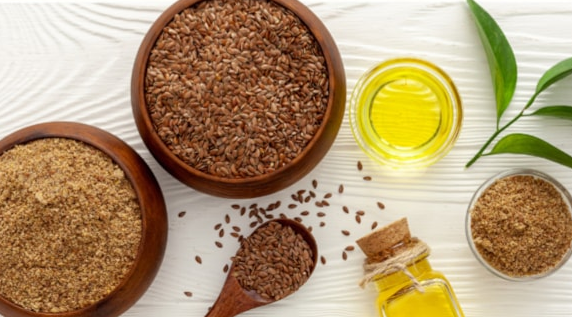

FLAXSEEDS FACTS WITH NUTRITIONIST DOMINIQUE LUDWIG
Flaxseeds are nature’s superfood or they can get misunderstood. Are they hormone disruptors or hormone balancers? Can you cook them, or will that destroy their nutrients? And do men really need to avoid them? Let’s separate the myths from the science.
WHAT ARE FLAXSEEDS?
Flax (Linum usitatissimum) is one of the most ancient, cultivated crops, grown for over 7,000 years and are prized both for the
flaxseeds themselves, their oil, as well as the flax fibre, found under the bark which is used to make linen.
NUTRITIONAL PROFILE OF FLAXSEEDS
Flaxseeds are a nutritional powerhouse and are a great source of protein and fibre containing around 23g protein and 20g fibre per
100g. They are also a rich source of minerals such as potassium, calcium, iron, magnesium and zinc as well as containing around 20g
omega 3 per 100g in the form of alpha-linolenic acid (ALA). They are also a rich source of plant compounds, in particular of polyphenol called lignan.
FLAXSEED MYTHS AND FACTS
MYTH 1: FLAXSEEDS MUST BE MILLED TO BE DIGESTED – MOSTLY TRUE
Whole flaxseeds have a tough outer coat made of cellulose and lignin, which can resist our digestion. If eaten whole and raw, most
of the seeds will pass through the digestive tract intact, meaning we won’t absorb many of their omega 3 fats, nutrients or lignans.
Cooking whole flaxseeds, for example in a bread can slightly soften the tough shell, however this is often not sufficient to rupture it
sufficiently to release its’ valuable cargo of nutrients on the inside. This means that again most of the seeds pass ‘through’ our digestive tract, rather than being broken down by our enzymes.
Most of the soluble fibre (the fibre your gut bugs love) is found inside the flaxseed. However, some of this fibre is found also on the
seeds surface, meaning our microbiome still get some benefit from whole flaxseeds, but much more from milled.
Cold-milled flaxseeds, such as those found in Linwoods products [3], therefore allow for better digestion and nutrient absorption,
maximising the anti-inflammatory and hormonal benefits of ALA and lignans.
MYTH 2: MILLED FLAXSEEDS MUST BE STORED IN THE FRIDGE – TRUE
Storing milled flaxseeds in the fridge, ideally in a sealed, opaque container or in their original packaging, helps to preserve freshness
and nutritional quality. Whole flaxseeds, in contrast, are naturally protected by their outer shell and can be kept in a cool, dark cupboard.
MYTH 3: COOKING FLAXSEEDS DESTROYS NUTRIENTS — MOSTLY FALSE
Flaxseeds and their oils are more heat stable than once believed. Research shows that baking at temperatures below 180°C causes little change in the ALA content of flaxseed oil or milled flaxseed. This means flaxseeds remain nutritionally intact when baked into bread, muffins or other foods.
This stability is partly because the centre of baked foods heats more slowly, protecting the seed’s interior. Minerals, fibre and lignans
are also highly heat stable. Roasting or grinding can lead to more losses as the overall temperature can become higher.
Frying with cold pressed flaxseed oil is not recommended, as these high temperatures can be too much for the oils and may oxidise the fragile omega 3 fats.
MYTH 4: FLAXSEEDS CAN UPSET HORMONE BALANCE – MYTH
Flaxseeds contain lignans, which can have a mild oestrogenic action in the body. They can bind to oestrogen receptors, a bit like a magnet, either blocking stronger oestrogens when levels are high or providing gentle support when levels are low. This is sometimes described as a balancing or modulating effect.
The oestrogenic effects of lignans are believed to be between 1000-10,000 times less potent than human oestradiol. In fact,
systematic reviews and meta-analysis show that there is no increased risk for breast cancer from consuming plant lignans but instead
indicate that lignan consumption may lead to a lower risk of breast cancer in postmenopausal women. There have been some concerns regarding those that have already had a breast cancer diagnosis, but most studies in this area also shows a neutral or mildly beneficial effect in postmenopausal women from continued flaxseed consumption.
MYTH 5: EATING A DIET RICH IN PHYTOESTROGENS CAN REPLACE HRT – MYTH
Flaxseeds are highly nutritious and support women’s health through menopause, but they cannot replace hormone replacement therapy (HRT). Their lignans are too weak to replicate oestrogen’s effects directly but can still plat a supportive role with milder benefits.
However, some women notice mild improvements in wellbeing during menopause, possibly due to lignans’ gentle hormonal modulation. More importantly, flaxseeds offer other significant benefits at midlife, supporting heart health, blood sugar control, bowel regularity and increasing levels of micronutrients.
MYTH 6: MEN SHOULD NOT EAT FLAXSEEDS – MYTH
Flaxseeds are beneficial for men too [5]. Clinical trials show that daily intakes of 25–30 g of ground flaxseed can lower LDL
cholesterol significantly in both men and women. Eating the correct amount is important for this benefit, and we need to be eating 2
heaped spoonfuls (25-30g daily) to reap the benefits – a small sprinkling might not be enough.
A 2008 randomised controlled trial in men awaiting prostate surgery found that 30 g per day of ground flaxseed reduced tumour cell
proliferation compared with control (Demark-Wahnefried et al., 2008).
MYTH 7: YOU CAN’T EAT FLAXSEEDS IF YOU HAVE AN UNDERACTIVE THYROID – MYTH
Flaxseeds contain small amounts of linustatin and neolinustatin, these are also known as are cyanogenic glycosides; these are natural plant compounds found in flaxseeds which can release small amounts of thiocyanate after digestion. Thiocyanate theoretically compete with the uptake of iodine in the thyroid gland. However, this concern is based on outdated animal research using extremely high flaxseed intakes, and not human studies and latest research (EFSA report 2019) indicates no risk from normal consumption and stated that flaxseed does not pose a risk for thyroid function in adults.
There is no evidence that flaxseed harms thyroid function in humans. A more practical precaution is simply to avoid eating flaxseed within an hour of taking thyroid medication such as levothyroxine, since its soluble fibre may delay absorption. Ensure you include iodine-rich foods such as seaweed, fish, dairy and shellfish to support healthy thyroid function.
MYTH 8: FLAXSEEDS CAN LEAD TO WEIGHT LOSS? MOSTLY MYTH
There is no evidence that eating flaxseed alone will lead weight loss, however the increased fibre could increase satiety and help regulate our appetite and blood sugar control which can suppress appetite and support weight loss, making it a useful addition to a structured, balanced diet. Flaxseeds are definitely a good food to be adding in to any weight loss programme!
MYTH 9: IT IS POSSIBLE TO GET ALL THE OMEGA 3 WE NEED FROM FLAXSEEDS – UNLIKELY
Flaxseeds provide ALA, a plant-based omega 3 fat that the body can convert into EPA and DHA, but this conversion is very limited (around 5% for EPA and slightly less for DHA).
The limiting factor is that the body’s enzymes are shared with omega 6 metabolism and cannot convert large amounts efficiently. Therefore, flaxseeds are an excellent supportive source of omega 3s [6] but cannot fully replace marine or algae-based DHA and EPA sources.
MYTH 10: FLAXSEEDS CAN HELP REDUCE CONSTIPATION – TRUE
Studies show that daily flaxseed intake (10–50 g per day) can significantly improve stool frequency, consistency, and ease of
passage. About two thirds of the fibre in flaxseed is insoluble, which adds bulk and stimulates motility, while one third is soluble mucilaginous fibre, which traps water and softens the stool.
For best results, drink plenty of water as fibre needs this fluid to swell and keep the stool soft. A serving of around 20 g per day alongside adequate hydration is ideal.
WAYS TO INCLUDE FLAXSEEDS IN YOUR DIET
* Stir into yoghurt: Add 20g of milled flaxseeds to natural yoghurt, loosen with kefir and top with berries for natural sweetness.
* In baking: Mix a tablespoon of milled flaxseeds into biscuit, muffin or power ball recipes for extra fibre and omega 3.
* Blend into smoothies: Add a spoonful of flaxseeds to your morning smoothie or protein shake to boost texture and nutrition.
* Bake into bread: Incorporate whole or milled flaxseeds into seeded loaf or bread recipes for added crunch and nutrients.
ABOUT DOMINIQUE LUDWIG, NUTRITIONIST MSC, REG. NUTRITIONIST, FBANT
Dominique Ludwig is one of the UK’s leading nutritionists, with over 20 years of clinical experience. She is a King’s College
London–qualified nutritionist, Registered Nutritional Therapy Practitioner (CNHC), and a Fellow of the British Association for Nutrition and Lifestyle Medicine (BANT).
Dominique’s no-nonsense, science-backed approach, combined with her calm authority and delicious recipes, has built a fast-growing online community of over 700,000 followers, alongside thousands of participants in her online health and nutrition programmes.
She is a trusted voice in the media, contributing to publications such as The Sunday Times, Times2, The Telegraph and SheerLuxe. She has also featured on BBC Radio and numerous podcasts. Alongside her media work, she runs a thriving clinical nutrition practice in the South Downs, where her private clients include award-winning actors and global business leaders.
Over the course of three decades, Dominique has worked with more than 4,500 people. She specialises in her signature group programmes, Renew Reset Recharge® and the Triple 30 Nutrition Plan, which have helped thousands achieve sustainable results and build long-term healthy habits. She is currently writing her first book.
She was recently awarded a Fellowship with BANT, recognising her outstanding expertise, leadership, and dedication to advancing the field of nutritional therapy.
Associations:
* FBANT – Fellow of the British Association for Nutrition and Lifestyle Medicine
* CNHC – Complementary and Natural Healthcare Council
Qualifications:
* MSc Nutrition, King’s College London, with Distinction
* Dip. Nutritional Therapy, with Distinction